Tarot
Tarot Beyond Divination
Symbolic philosophy, self-knowledge, and the work of transformation
A person can spend years asking the cards what will happen, where am I headed, what should I do next? Another question deserves the same attention. What can these images teach us about how we live?
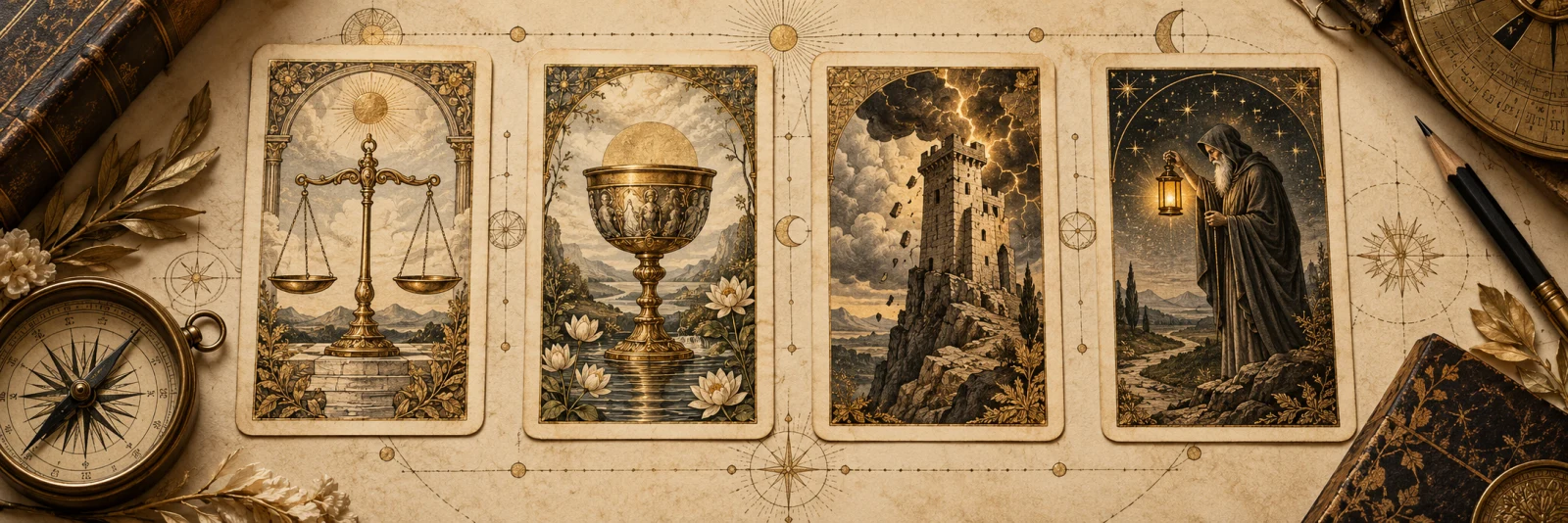
Tarot offers a language of figures, objects, gestures, and relationships. A crown suggests authority. A cup holds something that might nourish us or poison us. A tower stands until its foundations can no longer bear its weight. Such images invite thought before anyone assigns them a prediction.
Manly P. Hall made a forceful case for this broader use in The Secret Teachings of All Ages.
“Elaborate treatises have been written concerning the use of the Tarot cards in divination, but as this practice is contrary to the primary purpose of the Tarot no profit can result from its discussion.”
Manly P. Hall, “An Analysis of Tarot Cards,” The Secret Teachings of All Ages (1928).1
His objection follows an account of the suits as correspondences linking elements, society, and sacred cosmology. Hall approaches Tarot as a symbolic system through which a student might investigate existence.
A philosophical alphabet
Hall calls the cards “vowels and consonants of a philosophic alphabet.” Each expresses a principle, and their relationships express interactions among principles. He also describes them as “the key to the magical constitution of man.” Human nature and the wider universe become subjects for the same symbolic inquiry.2
His references to alchemical regeneration suggest a further concern with spiritual transformation. Reading him this way, Tarot becomes a means of education and inner development. This is an interpretation of his argument, rather than a complete method he supplies in the chapter.
A practical extension begins with sustained attention to a single image. Place Justice before you and consider the relationship between judgment and consequence. Consider how fairness changes when your own interests are involved. The card gives an abstract problem a visible form.
Meditation and attention
For a contemplative practice, choose a card deliberately. Sit with it for ten minutes. Observe the posture of its figures, the direction of their gaze, the objects they hold, and the spaces around them. Describe what is present before consulting a book of meanings.
Then notice your response. The Hermit’s solitude might feel like relief one morning and abandonment the next. That difference is material for reflection. The image remains available while your relationship to it changes.
Record one detail you had overlooked and one thought it brings forward. Repeated over time, this practice gives you a record of your attention.
Self-knowledge and the stories we carry
A card can serve as a prompt for examining a story you have accepted about yourself. The Emperor might bring authority into view. Consider where you need structure, where you resist it, and where your need for control costs someone else their freedom.
These are proposed reflective uses of Tarot. They do not establish that a card has diagnosed your character or disclosed another person’s motives. Their value depends on the honesty and specificity of your response.
A useful journal entry moves from image to incident. Describe a recent conversation, the words you used, what you wanted, and what you avoided. Then ask how the card changes your understanding of that encounter. Leave room for an interpretation that challenges your first impression.
Ethical reflection and deliberate action
Tarot can help frame a decision without taking responsibility for it. Select three cards to represent your desire, your obligation, and the likely cost of acting. Use each image to generate possibilities, then compare those possibilities with the facts.
Temperance might prompt you to consider proportion. Strength might invite patience in a conflict. Justice might bring an unpaid debt or an unacknowledged responsibility into focus. None of these associations settles the decision. They give you more to examine.
End with an action you can name. Make the apology. Set the boundary. Gather the missing information. A reading becomes more useful when its insight reaches ordinary conduct.
Creative work and symbolic study
Writers and artists can use Tarot as a store of situations. A figure departs. A ruler waits. A wheel turns. Choose two cards and write the scene that could connect them. Give the figures conflicting desires. Let an object in one image become the cause of an event in the other.
For philosophical study, arrange cards around a subject such as freedom, mortality, or power. Explain your choices. Move a card and see how the argument changes. This makes interpretation an activity you can revise, rather than a meaning you must receive intact.
History and spiritual meaning
Hall’s account of Tarot’s purpose belongs to an esoteric tradition. It should be distinguished from the deck’s documented beginnings. The earliest references place Tarot in fifteenth-century northern Italy, where it functioned as a trick-taking game. Its familiar occult associations developed later.3
Hall himself questions several occult claims, including assertions about Egyptian initiation and fixed Hebrew-letter correspondences.4 His chapter combines conviction about symbolic meaning with uncertainty about parts of its transmission.
A later spiritual use can have value without being the original purpose of an object. We can study the history of the cards while also finding meaning in the practices that grew around them.
Tarot offers occasions to attend, imagine, question, and act. Lay down a card. Study what it shows. Follow the thought into your own life, where it must answer to what you do.
Endnotes
- Manly P. Hall, The Secret Teachings of All Ages (San Francisco: printed for Manly P. Hall by H. S. Crocker Company, 1928), “An Analysis of Tarot Cards,” paragraph beginning “The four suits of the minor trumps.” The quotation reproduces the wording in the supplied image. The bibliography identifies the original 1928 imprint rather than the later publisher attribution shown in that image. Chapter and paragraph locators are used because pagination varies among editions. Full-text digital copy.
- Hall, “An Analysis of Tarot Cards,” paragraphs beginning “Many symbols appearing upon the Tarot cards” and “The Tarot cards must be considered.” Online transcription. The meditation, journaling, decision, and creative exercises in this article are practical proposals by the article’s author, rather than exercises attributed to Hall.
- Tim Husband, “Before Fortune-Telling: The History and Structure of Tarot Cards,” The Metropolitan Museum of Art, April 8, 2016. Read online. Husband discusses the early documentary references and Tarot’s use as a game.
- Hall, “An Analysis of Tarot Cards,” discussion of P. Christian’s Egyptian initiation narrative and the paragraph beginning “Most writers on the Tarot.” Hall’s reservations do not amount to a modern scholarly history of Tarot.
Bibliography
Hall, Manly P. The Secret Teachings of All Ages: An Encyclopedic Outline of Masonic, Hermetic, Qabbalistic and Rosicrucian Symbolical Philosophy. San Francisco: Printed for Manly P. Hall by H. S. Crocker Company, 1928. “An Analysis of Tarot Cards.” Online transcription.
Husband, Tim. “Before Fortune-Telling: The History and Structure of Tarot Cards.” The Metropolitan Museum of Art. April 8, 2016. https://www.metmuseum.org/perspectives/tarot-2.