The Homeromanteion
Chance meets a verse
A small library of Homeric lines, reached through three throws of a die.
← Return to casting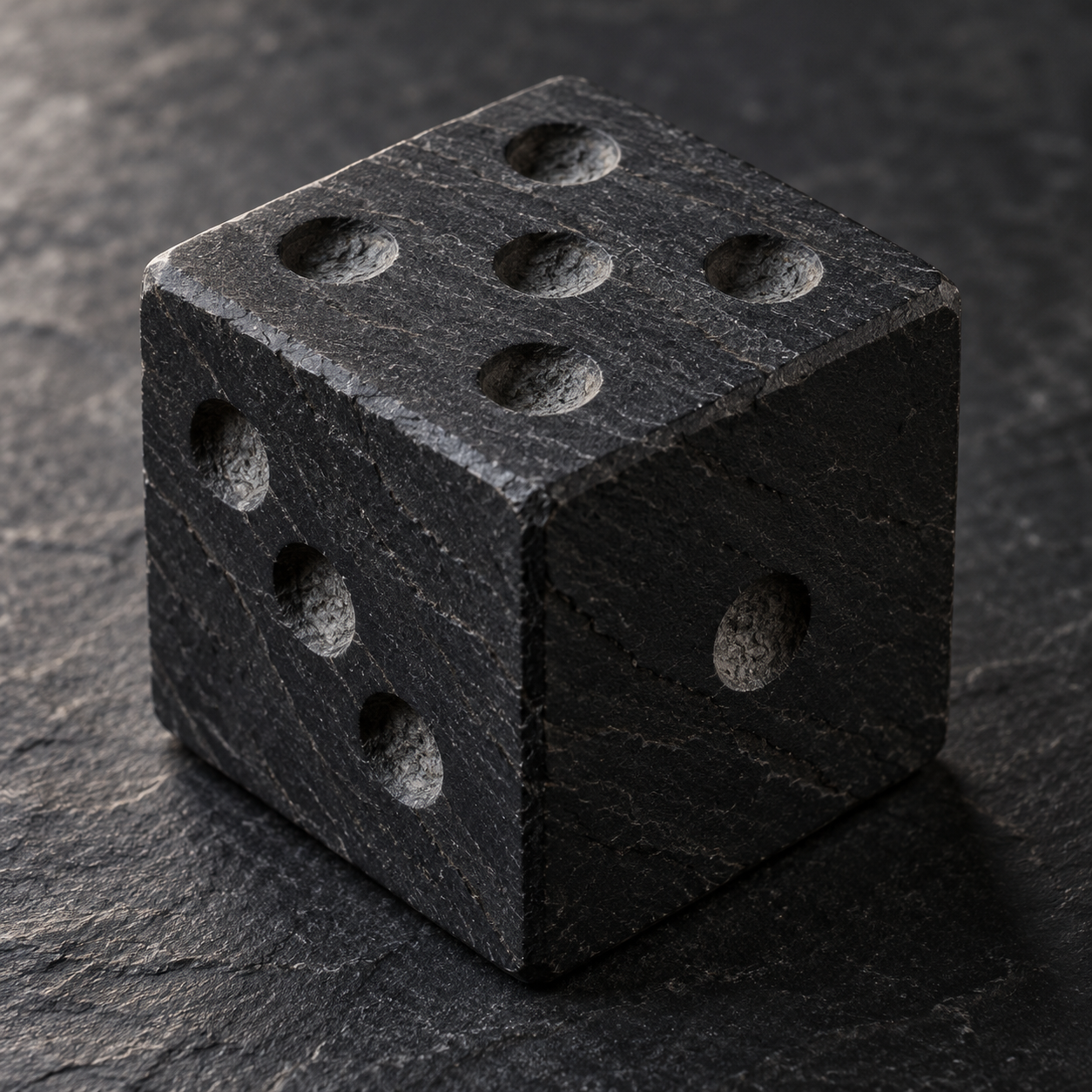
How to consult it
- Settle on a question. You may keep it in mind or write it on the casting page.
- Roll an ordinary six-sided die three times. Alternatively use three dice with a fixed first, second, and third position.
- Record the results in order: 1–3–3 and 3–1–3 are different entries. Do not sort or total them.
- Read the corresponding verse and consider how its imagery relates to your question.
Six possibilities in each of three positions give 6 × 6 × 6 = 216 sequences. With fair dice every sequence has probability 1/216. The digital cast uses the same equal-probability model.
Choose polished bone with black slate pips, or black slate with carved pips, using the selector above the dice. Read the upward-facing value; the two visible sides are not additional results. Both cube designs are modern visual choices made for Alchemysterium, not a reconstruction of a surviving ancient set of dice.
Dice and bibliomancy
The dice choose a passage from a fixed collection of lines drawn from the Iliad and Odyssey. This is a form of lot divination using literature. It differs from opening a whole book at random: each ordered roll has a designated entry.
The surviving instructions in P.Oxy. 3831 prescribe suitable days and times, a prayer to Apollo, and three throws. This site offers the lookup without enforcing that ritual timetable.
About this text
The ordering and Homeric references follow Franco Maltomini’s 1995 edition of the Homeromanteion, which compares the London, Oxyrhynchus, and Bologna witnesses. Some older tables assign different verses to early rolls. This edition is used consistently throughout this site.
Each English passage is an original concise paraphrase of the ancient verse, not a quotation from an English translation. Names, fragments, and uncomfortable imagery are retained where they matter. These paraphrases are reading aids, not a critical translation or a reproduction of the papyrus’s Greek spelling.
There are 200 identified positions, eight uncertain positions, and eight missing positions in this presentation. “Identified” includes text restored by scholars from Homer or parallel manuscripts; it does not mean every letter survives. An uncertain passage is labeled. A missing verse stays missing and is never silently replaced by another roll.
The edition’s entries 45–47 and 64–68 are lost; 27, 41, 42, 44, 48, 62, 110, and 172 have identification problems of varying kinds. The table and individual readings explain these limitations. The full edition contains more detailed textual apparatus.
Some lines recur in several places in Homer. Each reading provides one reference and, where applicable, notes parallels. The linked Greek passage supplies literary context; the oracle’s wording can differ from that text.
Reading a fragment
A line detached from an epic can feel surprising or incomplete. Start with its concrete action: waiting, returning, refusing, defending, giving. Notice what it brings into focus without forcing every detail to fit.
For example, 3–3–4 selects Iliad 18.328: Zeus does not fulfill every human intention. A modern question to sit with might be: “Which part of this situation can I influence, and which part must I release?” That reflection is an editorial suggestion, not an ancient interpretation.
War, death, threats, and hostile judgments belong to the poems’ stories and speakers. They are not instructions, reliable forecasts, or endorsements. Read them as literary material for reflection.
Your question and reading
Casting and lookup happen in your browser. The oracle does not send or automatically store your question. Editing the question or dice clears the previous reading so it cannot be mistaken for a new answer. Save to Scriptorium stores a private copy when you are signed in. Share Reading offers image, PDF, and text exports. Saving, sharing, downloading, or printing includes the question if you entered one.
References
- Franco Maltomini, “P.Lond. 121 (= PGM VII), 1–221: Homeromanteion”, Zeitschrift für Papyrologie und Epigraphik 106 (1995), 107–122. Principal edition; oracle entries on pp. 111–118, apparatus and index on pp. 118–122.
- P.J. Parsons, P.Oxy. LVI 3831, The Oxyrhynchus Papyri 56 (1989), 44–48. Instructions and opening entries; discussed and collated in Maltomini.
- R.W. Daniel and F. Maltomini, Supplementum Magicum II (1992), no. 77, pp. 147–150. Bologna witness; discussed in the 1995 edition.
- Sarah Iles Johnston, Ancient Greek Divination (Wiley-Blackwell, 2008), pp. 99–100 and 169. Context for dice divination, bibliomancy, and the Homeric oracle.
- Raquel Martín-Hernández, “Using Homer for Divination: Homeromanteia in Context”. Discussion of manuscripts, consultation, and the reuse of epic verses.
- Perseus Digital Library / Scaife Viewer. Linked Greek Homer passages for comparison and literary context.
English paraphrases and reflection prompts: original Alchemysterium editorial material, 2026. Slate artwork generated for this site using the approved carved-slate concept. No modern published English translation is reproduced.